How an AI Workflow Can Revolutionise Genealogy Projects
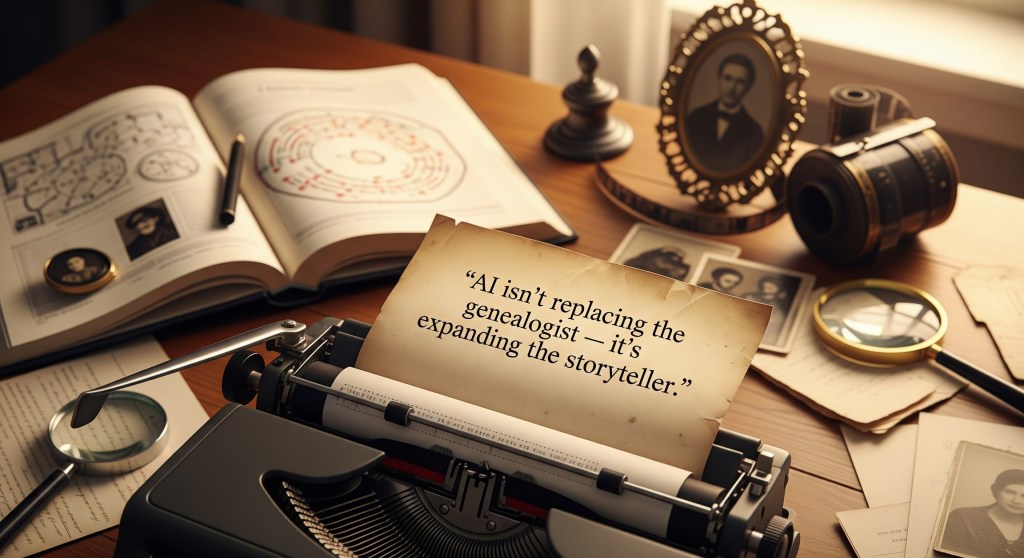
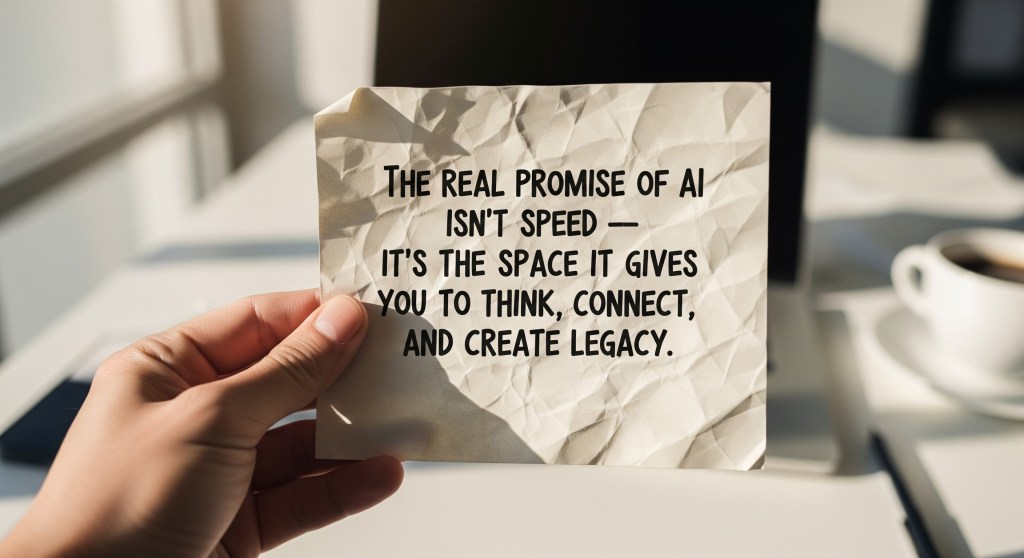
Notes about images! Each image below was generated inside this Google Doc using the latest feature inside the Image function – called Generate an image. The first image from this prompt and subsequent images using a pull quote.
Title image prompt (for Gemini 2.5):
A genealogist’s desk blending old and new — an open parish register, a glowing laptop screen with a family-tree diagram, morning light across scattered papers, and a soft sepia-blue palette.

The Shift
The early thrill of “What can ChatGPT do for me?” has passed.
Now genealogists are asking, “How can AI actually change the way I work?”
Those who once used AI for small wins — a transcription here, a tidy paragraph there — are ready for something deeper: a way to weave it through the entire research process without losing accuracy or soul.
That’s where an AI workflow comes in. Not automation for its own sake, but a design that keeps you in charge while the tools handle the heavy lifting. Once built, every project moves faster, stays cleaner, and leaves more space for insight.
Pull quote:
The Problem
Most genealogists still work in fragments. AI helps one task, but the results scatter. Files multiply. Context fades.
Without a workflow, efficiency collapses under its own clutter.
And a quiet danger creeps in — AI drift — when unchecked suggestions start rewriting the facts. The solution isn’t more output; it’s more structure.
The Solution: The Workflow Mindset
A workflow brings discipline to the magic — a repeatable, human-led, AI-supported sequence from raw record to finished narrative.
- Plan – Define your research question; let AI reveal record types and archives you might miss.
- Gather – Use AI to extract, transcribe, and organise data from images, PDFs, and notes.
- Analyse – Compare sources, detect contradictions, and build timelines that reveal patterns.
- Write – Turn verified data into living stories with voice, emotion, and historical context.
- Publish – Summarise, tag, and archive your work so others can follow your trail.
Pull-quote:
Real Benefits
Once you think in terms of workflows, the benefits ripple outward.
- A household table that took three hours now forms in fifteen minutes with structured prompts.
- A blank page becomes a story spark through AI-assisted outlines.
- Citation lists, blog metadata, and course materials draft themselves while you fine-tune tone and emphasis.
But the deeper benefit is reflection. When AI summarises your work back to you, gaps and assumptions surface. You see your own reasoning more clearly — and that keeps the research honest.
Advanced Moves
Custom Frameworks. Capture your habits as templates — Record Review, Ancestral Story, Verification Loop. Codify what works.
Multi-Tool Pipelines. Use ChatGPT for analysis, Perplexity for corroboration, Canva for visuals, and Descript for voice-overs. Keep naming conventions tight so each ancestor’s path stays traceable.
AI-Aided Ideation. Ask for story angles or migration hypotheses. Let AI stretch your imagination, not lead it.
And always pause for the human check — instinct and empathy remain your best instruments.
Pull quote:
Your Challenge
Choose one ancestor.
Guide them through all five phases: Plan → Gather → Analyse → Write → Publish.
Then stop and reflect — what changed in your process, your accuracy, your energy?
That reflection marks the shift from AI user to AI partner.
Join the next AI Workflow Mastery session in the Thursday GenAI Club to map these principles onto your own project. Together we’ll build systems that save time and deepen the craft of research and storytelling.
Because in the end,
As always I encourage your comments here or within my social media sites. YouTube Channel for Essential Genealogy 2.0, my Facebook group, The Thursday GenAI Club or my email genealogist @ coachcaroleonline.com

