An AI-Powered Guide to Your Genealogy Journey
Introduction: Your Family Story is Waiting
Getting started with family history can feel like assembling a puzzle with a million tiny pieces. You find yourself buried under a mountain of names, dates, and dry documents. You wonder how these scattered facts will ever form a compelling story. What if you had a powerful assistant to help you make sense of it all?
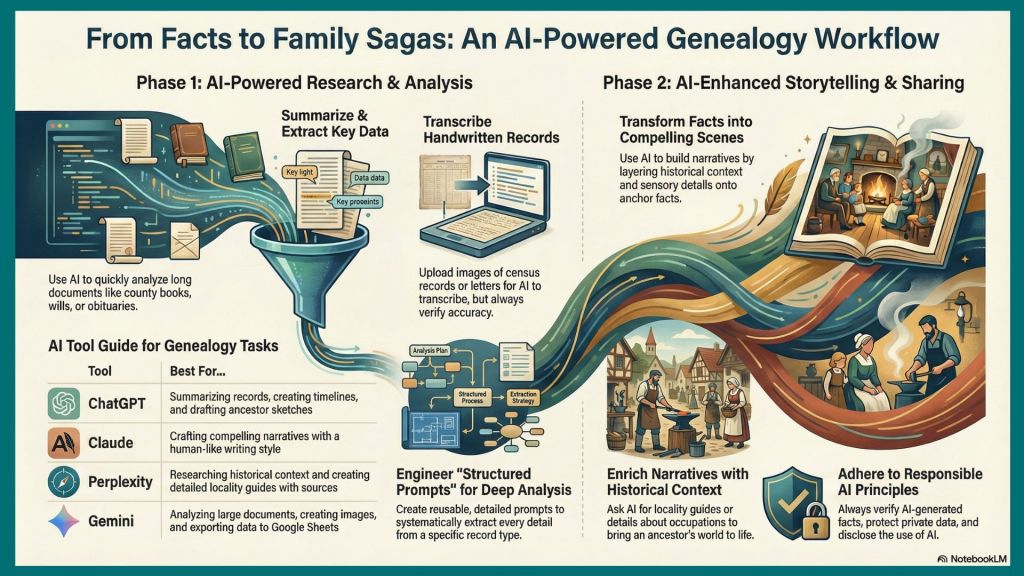
This guide introduces that assistant: Artificial Intelligence (AI). Think of AI as a tireless partner. It can help you transform raw data into a vivid family saga, not as a replacement for your research. We will walk you through a simple, two-phase workflow. The first phase involves using AI to streamline your research and analysis. The second phase uses AI to help you weave those findings into a story worth sharing.
——————————————————————————–
1. Phase 1: AI-Powered Research & Analysis – Uncovering the Clues
This first phase is all about efficiency. You don’t have to spend hours manually sifting through dense records. You can use AI to quickly process historical documents. It helps to extract the key facts that form the foundation of your family’s story.
From Dusty Documents to Digital Data
AI tools are particularly skilled at analyzing the types of records that are central to genealogy. You can use them to quickly make sense of digitized documents like:
- County books
- Wills
- Obituaries
- Census records
- Handwritten letters
Your Core Research Tasks
In this phase, AI primarily helps with two critical tasks: summarizing documents and transcribing handwriting. You can learn to engineer structured prompts. This is an advanced technique. It ensures you extract every possible clue from a record to perform these tasks with the greatest accuracy and depth.
- Summarize & Extract Key Data: AI can rapidly read through long and complex documents, pulling out the most important information. For a beginner, this is invaluable. It helps quickly identify key names, dates, locations, and relationships. This occurs without getting lost in archaic language or dense text.
- Transcribe Handwritten Records: Deciphering old handwriting is one of the biggest challenges in genealogy. AI can analyze scanned images of letters or census forms and produce a typed transcription. However, this technology isn’t perfect, so it’s crucial to approach it with a critical eye.
- Engineer Structured Prompts for Deep Analysis: This involves creating reusable and detailed prompts. These prompts systematically extract every detail from a specific type of record. Examples include a will or census entry. For example, you create a prompt that instructs the AI to find the names in a will. It should also identify the relationships, the specific items bequeathed, the witnesses, and the date it was signed. This advanced technique ensures consistency and thoroughness in your data extraction.
Choosing the Right AI Tool for the Job
Different AI models have different strengths. Choosing the right one for your specific task can lead to better and more efficient results.
| AI Tool | Best Used For… |
| ChatGPT | Summarizing records, creating timelines, and drafting ancestor sketches. |
| Claude | Crafting compelling narratives with a human-like writing style. |
| Perplexity | Researching historical context and creating detailed locality guides with sources. |
| Gemini | Analyzing large documents, creating images, and exporting data to Google Sheets. |
Once you’ve used AI to gather the essential facts, the next step is to bring those facts to life.
——————————————————————————–
2. Phase 2: AI-Enhanced Storytelling & Sharing – Weaving the Narrative
With your foundational research complete, this phase is about moving beyond a list of facts and dates. Here, you’ll use AI as a creative partner. Together, you will build engaging narratives that capture the imagination. These narratives will honor your ancestors’ experiences.
Transforming Facts into Compelling Scenes
The art of historical storytelling uses the “anchor facts,” you know. You can imaginatively and responsibly reconstruct the world your ancestors inhabited. The key is to start with verifiable pieces of information you uncovered in Phase 1. From there, you can use AI to build a narrative. It involves layering historical context and sensory details onto those facts. This transforms a simple event into a compelling scene.
Enriching Your Story with Historical Context
To make your family’s story feel authentic, you need to understand the world they lived in. You can ask an AI to provide specific details that will make your narrative more vivid and accurate. For example, you could try:
- Request “locality guides.” These guides help to understand the social and economic environment of the town or region. They also provide political context where an ancestor lived.
- Requesting details about an ancestor’s occupation—such as a blacksmith—to bring their daily work, tools, and challenges to life.
As you begin crafting these powerful stories, it’s vital to do so responsibly and ethically.
——————————————————————————–
3. Guiding Principles: Using AI Responsibly in Your Research
AI is an incredibly powerful tool for genealogists. However, its use requires a thoughtful and principled approach. This ensures your work is accurate and ethical.
- Always Verify An AI can make mistakes or “hallucinate” information that sounds plausible but is incorrect. A genealogist’s primary duty is to the integrity of the source material. Always double-check any facts, dates, or relationships generated by AI against original source documents. Your primary sources are the ultimate authority.
- Protect Private Data Be extremely cautious when inputting information about living relatives into AI platforms. Inputting personal data of living individuals into public AI models can expose it to the model’s training data. This can create significant privacy risks. To protect their privacy, avoid sharing sensitive personal details.
- Disclose AI Use When you share your work, it is good practice to disclose that you used AI. This assists in your research or narrative creation. This promotes transparency. It manages expectations for other researchers who view your work. It upholds the academic and genealogical standards that are vital to our community.
——————————————————————————–
Conclusion: Start Your AI-Powered Journey
Your family history is more than just a collection of records; it’s a saga waiting to be told. By following this simple workflow, you can harness the power of AI to navigate your research with greater ease. Then, you can craft the compelling stories that lie hidden within the data.
Start by gathering the clues with AI as your research assistant, then let it become your creative partner in storytelling. Your AI-powered journey into the past begins now.

