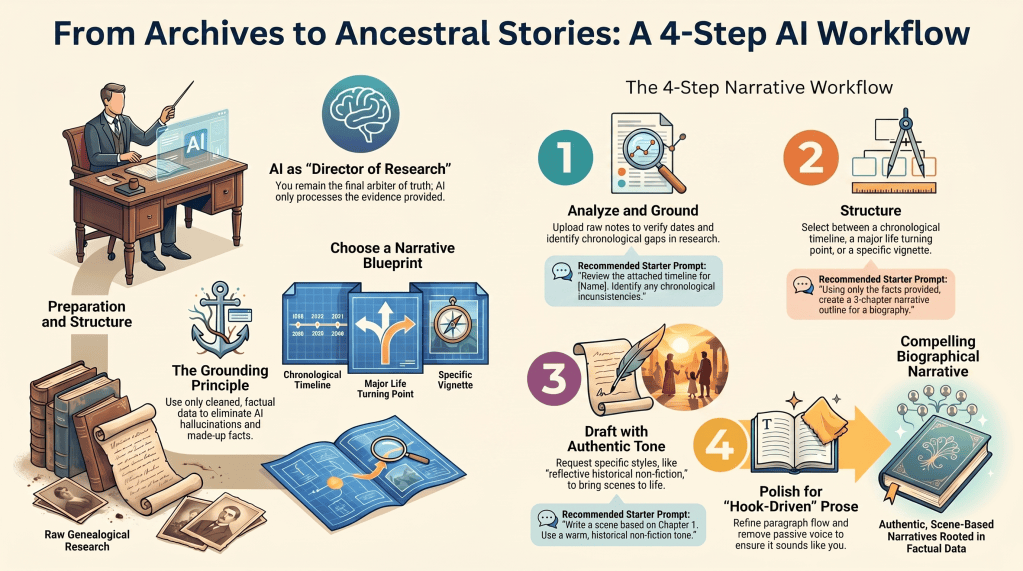
The Four-Step Workflow for a Polished Narrative
To move safely from a messy profile to a published-quality draft, follow this structured technologist’s workflow. Use these exact prompts to maintain control over the process. [Substitute your data in the square brackets.]
Step 1: Analyse (The Groundwork)
Upload your raw timelines and notes. Ask the AI to identify chronological gaps and historical intersections. Suggested Prompt: “Act as an expert historical researcher. Review the attached timeline for [Ancestor Name] and [my research notes]. Identify any chronological inconsistencies, missing life segments, or interesting historical intersections.”
Step 2: Blueprint (The Structure)
Instruct the AI to create an outline based only on your provided facts. Suggested Prompt: “Using only the facts provided in the timeline, create a 3-chapter narrative outline for a short biography. Focus heavily on [their decision to emigrate in year].”
Step 3: Draft (The Drafting)
Feed the AI one section of the outline at a time to maintain granular control over the tone. Suggested Prompt: “Write a narrative scene based on Chapter 1 of the outline. Use a warm, engaging, historical non-fiction tone. Do not invent any new names, dates, or locations not present in my notes.”
Step 4: Polish (The Editing)
Refine the output to ensure the voice is authentically yours. This is where you eliminate “AI-speak” and repetitive vocabulary. Suggested Prompt: “Review this draft paragraph. Improve the flow, remove passive voice, and suggest three different opening sentences to make it more hook-driven for a general reader.”

The full guide for writing family stories with AI is available as a digital download from the Essential AI Genealogy Academy.
Family History Writers’ AI Toolbox
The Mini Course for Family Historians: First Steps with AI is available for enrolment.

