If you’re a genealogy enthusiast, you’ve undoubtedly heard the buzz around AI tools like ChatGPT. The promise is alluring: an all-knowing assistant to crack your toughest brick walls. Most people approach these tools like a simple question-and-answer machine, a super-Google stuck in “first gear.”
But what if I told you that this basic understanding is holding you back? What if the biggest frustrations you have with AI are not bugs? The made-up facts and bizarre editing quirks are fundamental features you need to understand to use it effectively. Let’s pull back the curtain. We will reveal five crucial truths about how these AI tools actually work for family history research. These truths are often counter intuitive. It’s time to learn how the engine is built so you can truly take it for a spin.
Takeaway 1:
AI Isn’t One Tool, It’s a Whole Toolbox
You’re Using one Golf Club, But You Have a Whole Bag
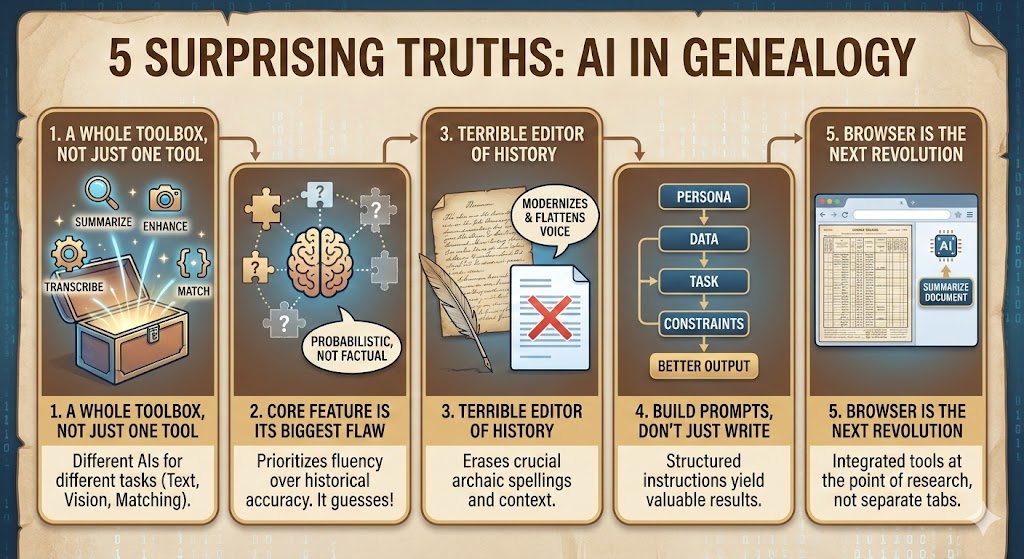
The single biggest mistake researchers make is treating “AI” as one thing, usually ChatGPT. This is like playing an entire round of golf with only your five iron. You get around the course, but you’re leaving a massive amount of potential on the table. In reality, the AI landscape is a full bag of specialized clubs, each designed for a different shot.
Using the right model for the right task can dramatically change your results. Here’s a quick breakdown of the strengths of different popular models:
- ChatGPT: The best-known all-rounder, a versatile tool for a wide range of tasks.
- Claude: Excels at producing natural, human-like writing, making it a great choice for drafting narratives or ancestor biographies.
- Gemini: Powerful for analyzing large documents and datasets, ideal for sifting through a 76-page GEDCOM export.
For a genealogist, this is transformative. You wouldn’t use a narrative-writing tool to analyze complex records. Similarly, you wouldn’t use a data-analysis tool to write a flowing family story. Choosing the right “club” for the job is the first step toward getting professional-grade results.
“It’s as if people were just using their five iron, and they can walk the whole golf course with it. Then all of a sudden, they’ve got 12 other clubs to choose from. It freaked people out because they liked their favorite five iron. They took their favorite five iron away. They gave them 12 new things. They didn’t know what to do with them.”
Takeaway 2:
Its Biggest Flaw Is Actually Its Core Feature
Hallucinations Aren’t a Bug; They’re a Feature
Every AI user has encountered it: the confident, plausible, and completely fabricated “fact.” These “hallucinations” are the most well-known problem with AI, but understanding why they happen is a game-changer.
Here’s the counter intuitive truth: AI models are not designed to be fact databases. They are designed to be creative. During their training, the models were “overprogrammed or over conditioned.” They would guess even incorrectly rather than simply saying “I don’t know.” Their core function is to recognize patterns. They creatively generate the next word in a sequence. They do not access a vault of verified information.
This insight brings us to the new golden rule of AI-assisted genealogy. Instead of thinking the AI is “stupid” or broken, you should recognize when it invents a source. It is just doing what it was built to do: be creative. This means every interaction should begin not with “Is this fact true?” but with “How can this creative suggestion point me toward real records?” Every single claim, date, name, and place it generates must be independently verified with original sources. You, the researcher, are the final authority.
“…it’s not a bug. It’s a feature. This is by design. These tools are made to be creative. What people don’t understand is they think the tools are just a little bit stupid. However, they’re made to be creative. So, when they trained these tools, they didn’t want them to say ‘I don’t know.’”
Takeaway 3:
It’s a Terrible Editor (For a Surprising Reason)
It Can’t Just Change One Word for You
Have you given an AI a long, carefully written document—like a transcribed will or a biographical sketch? Have you asked it to make one tiny change, like correcting a single name? And have you watched in horror as it rewrites the entire document, introducing new errors or altering your original phrasing? This isn’t just a quirk; it’s a core technical limitation.
AI models have a very difficult time with “selective editing.” This behavior is a direct consequence of its core design. It does not ‘edit’ your words. Instead, it is creatively regenerating a new text based on the pattern of your original document and your new request. Instead of surgically changing one part, the model analyzes your entire text. It considers your new instruction. Then, it recreates the whole document from scratch.
This process is why unwanted changes can appear anywhere in the text. This behavior is most pronounced when the AI gets “lost in translation” on large, complex files. Models are often “smarter at the start and at the end.” In the middle is where it gets dumb first. For genealogists, this explains why editing transcripts or proofreading reports with AI can be so frustrating. The key is to be aware of this behavior. You should meticulously re-check the entire output. Do not focus only on the part you asked it to change.
“AI tools exhibit some weird behaviors. They have a really hard time reaching in and changing the one thing you ask them to. They excel at taking the entire thing that you did. Then, they recreate it and do their best to listen to the one request that you gave them.”
Takeaway 4:
Stop Writing Prompts. Start Building Them.
You Should Be Using AI to Build Your Prompts
Most users ask simple questions. Power users are learning to build complex, reusable tools. The secret is a technique called “meta-prompting”: using AI to help you build better, more structured prompts. This elevates you from asking a simple question to creating a rigorous, repeatable research methodology.
Here’s a three-step process for creating a reusable prompt to analyze a specific document type, like a WWII draft card:
- Step 1: Ask the AI to be your archivist. Give an example of the record to the AI and have it identify the general class of the document (e.g., “World War II Selective Service Registration Card, DSS Form 1”).
- Step 2: Command the AI to become a historical expert. Ask the AI to research from credible sources. These sources are the National Archives. Find all the information that class of record can contain. What does every field mean? What are the historical contexts?
- Step 3: Build a structured protocol. Using the comprehensive research from step two, instruct the AI to build a detailed and structured prompt. Create a systematic protocol designed to extract every piece of information from any document of that type.
This method transforms AI from a simple transcription tool into a system that aligns with the Genealogical Proof Standard (GPS). By researching the “universe of data” a record type contains (Step 2), you are directly addressing the GPS requirement. This is for “reasonably exhaustive research” that occurs before you even analyze a specific document. You can save these protocols on different platforms. At OpenAI, they’re called custom GPTs. Anthropic calls theirs projects. Google calls them gems. This isn’t about replacing the genealogist. It’s about “bottling methodology” to augment your skills. This ensures a consistent and thorough analysis every single time.
“This is meta-prompting—using AI to help you craft better prompts for AI. And yes, when we first started doing this, it felt like cheating… But here’s what we’ve learned: it’s not cheating to use the right tool for the job. It’s engineering. Context engineering.”
Takeaway 5:
The Next Revolution Isn’t the Chatbot, It’s Your Browser
The Future of AI Research Is Your Web Browser
The current AI workflow for online research is, frankly, goofy. We find a record on a genealogy website and copy the information. Then, we open a new tab and paste it into a chatbot. We get an analysis and then copy it back into our notes. This clumsy process is about to change dramatically.
The next major evolution in AI is the AI-enhanced browser. Tools like Perplexity’s Comet are integrating the AI directly into your web browser. This allows it to “see” and interact with the page you’re currently viewing. Imagine having an AI assistant “surfing beside you.” It will instantly summarize a complex historical article. It will also extract all the names from a digitized census page. It will translate a foreign-language document without ever leaving the tab.
For family historians, this will be revolutionary. It will eliminate the tedious copy-paste-copy cycle and dramatically streamline the process of analyzing online records, articles, and databases. Research will become faster, more seamless, and more deeply integrated into the tools we already use every day.
“The amazing cool thing about this new browser war… is for your chatbot to view the web page you’re on. So, we no longer need to do the goofy thing of copying stuff back and forth into our chatbot… we don’t have to do that anymore.”
Conclusion:
The Human in the Loop
Using AI effectively in genealogy requires a paradigm shift—moving beyond simple questions to understand how the machine truly thinks. The real power comes from choosing specialized tools. Embracing its creative “flaws” as features also contributes. Additionally, engineering reusable analytical protocols is crucial. The focus should be on directing the AI with precision and expertise, not just letting it do the work.
These tools are incredibly powerful assistants, but they are not the expert in the room—you are. As we integrate AI more deeply into our work, the genealogist becomes more crucial than ever. They provide critical thinking, verification, and ethical oversight.
You now know how the engine really works. What is the first genealogical ‘brick wall’ you will try to break through using these new insights?


2 responses to “The 5 Surprising Truths About Using AI for Genealogy”
Hmm. “It will eliminate the tedious copy-paste-copy cycle and dramatically streamline the process of analyzing online records, articles, and databases. Research will become faster, more seamless, and more deeply integrated into the tools we already use every day.”
It’s the tedious part where I find myself reading, absorbing and analyzing information. I fear that faster research will not allow me to do that.
LikeLike
Absolutely! Using split screens and tab groups on any of my browsers is also recommended as part of the workflow.
LikeLike