
RootsTech Unpacking Gems from Roots Tech today I discovered some new AI tools:
1. the AI assistant at Family Search, and
2. the Read Aloud tool in Chat GPT 4.
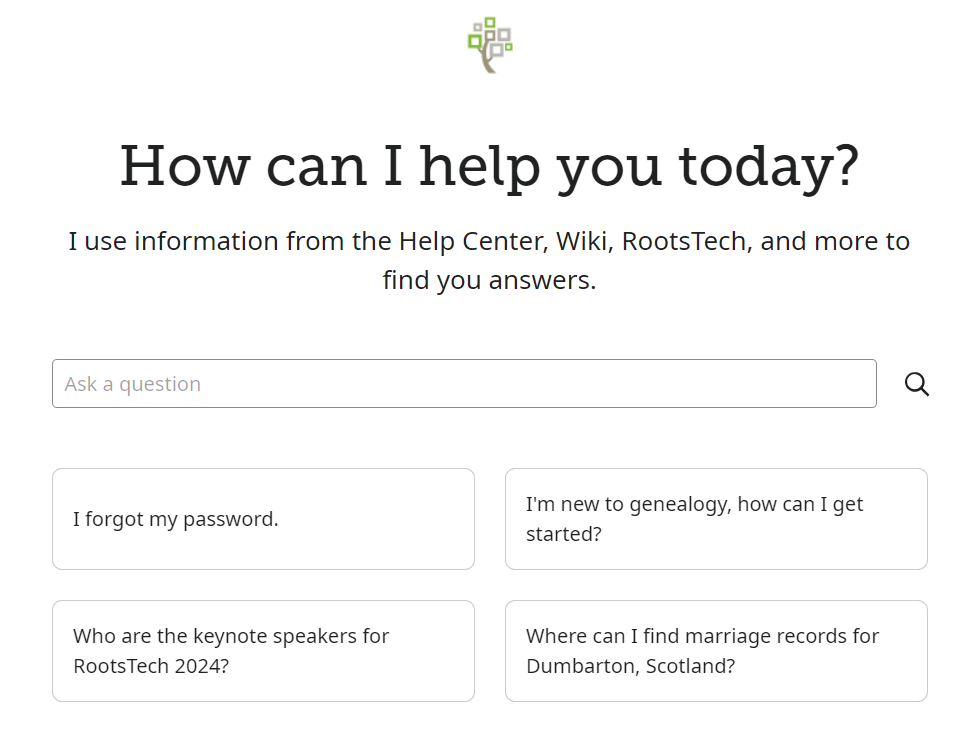
Today I went back to basics to see if there was anything new I could add to my genealogy journey. I visited the new AI assistant in Family Search to ask a question.
My prompt was: I’m new to genealogy, how can I get started? Family Search AI Assistant gave me the response you see below – 6 enumerated points.
With my trusty Chat GPT 4 beside me, I asked this simple prompt:
Please expand on this information about how to begin with genealogy.
- Identify what you already know about your family: Talk to relatives, look for documents and artifacts in your home, and gather information about dates, places, and events in your family’s history [1].
- Decide what information is missing and what you want to learn: Determine what specific details you want to find out about your ancestors, such as dates, names, or other specific facts [1].
- Explore what you already have: Before jumping online, explore the documents, photographs, and stories you already have at home. Talk to family members and gather valuable information from them [2].
- Start researching: Begin your research by searching for vital records like birth, marriage, and death records. Church and census records can also provide additional information about your family [1].
- Evaluate the information you find: As you gather information, evaluate its completeness and accuracy. Look for inconsistencies and use the information as clues to find other useful information [1].
- Preserve and share your findings: Share the information you’ve gathered with others by using online platforms like FamilySearch to store and share your family history. This can also help you connect with others who may have additional information [1][3].
Chat GPT 4, responded with the text you see below.
Embarking on the journey of genealogy can be a thrilling and enriching experience, offering a unique window into your family’s past and a deeper understanding of your heritage. To navigate this fascinating endeavor, consider the following expanded steps as your roadmap:
- Initiate with the Known: Begin by compiling everything you already know about your family tree. This involves engaging in conversations with family members, scouring your home for any relevant documents, photographs, and heirlooms, and jotting down known facts about your ancestors’ dates, places of birth, marriage, death, and significant life events. This foundational step helps create a preliminary sketch of your family’s history, providing a solid starting point for deeper investigation.
- Identify Gaps and Set Goals: Once you have a basic understanding of your family history, take a moment to identify what information is missing or unclear. Determine specific objectives for your research, such as uncovering the birthdate of a great-grandparent or tracing the lineage back to a particular ancestral homeland. Setting clear, achievable goals will guide your research efforts and help keep you focused.
- Dive into Home Resources: Before venturing into online databases or archives, thoroughly examine the resources you already possess. Family albums, letters, diaries, and even old receipts or certificates can be goldmines of information. Engage older family members in conversations; their stories and memories can offer invaluable insights and lead to discoveries that documents alone cannot provide.
- Embark on Research: With a clear research direction, begin exploring vital records such as birth, marriage, and death certificates, which are fundamental to genealogical research. Expand your search to include census records, church registers, military records, and immigration documents. These sources can reveal detailed information about your ancestors’ lives, relationships, and movements.
- Assess and Verify Findings: As you gather information, critically evaluate its reliability and relevance. Cross-reference dates, names, and places to ensure accuracy, and remain cautious of potential inconsistencies or errors. This critical assessment not only enhances the credibility of your research but also helps refine your search strategy by identifying new avenues of inquiry.
- Preserve and Disseminate Your History: Sharing your genealogical discoveries is as important as the research itself. Utilize online platforms such as FamilySearch, Ancestry, or MyHeritage to document and share your family history. These platforms also enable you to connect with distant relatives and fellow researchers who might hold pieces of your ancestral puzzle. Moreover, consider creating digital backups of documents and photographs to ensure the preservation of your findings for future generations.
Remember, the pursuit of genealogy is more than a mere collection of names and dates; it’s a continuous exploration that brings your ancestors’ stories to life. As you delve deeper into your family’s past, you’ll likely encounter surprises, challenges, and moments of profound connection. Enjoy the journey, Coach Carole, and may your research uncover fascinating chapters of your family’s unique story.
I was also able to ask Chat GPT 4 to Read Aloud. Yes, you heard right. Chat GPT 4 now has a voice. Here is my latest video tutorial on the Read Aloud feature.
How can the Chat GPT voice help me with genealogy?
As this is a brand new feature, only discovered today, I have yet to unpack its potential for me as a genealogist. However, the two things that I learned from using the Read Aloud tool today, were:
1. I was able to focus on different aspects of the information by listening to another voice reading out loud.
2. I realised the value of spoken scripts for someone who is visually challenged.
Try out the newest feature from Chat GPT 4 – listen to the Voice.

