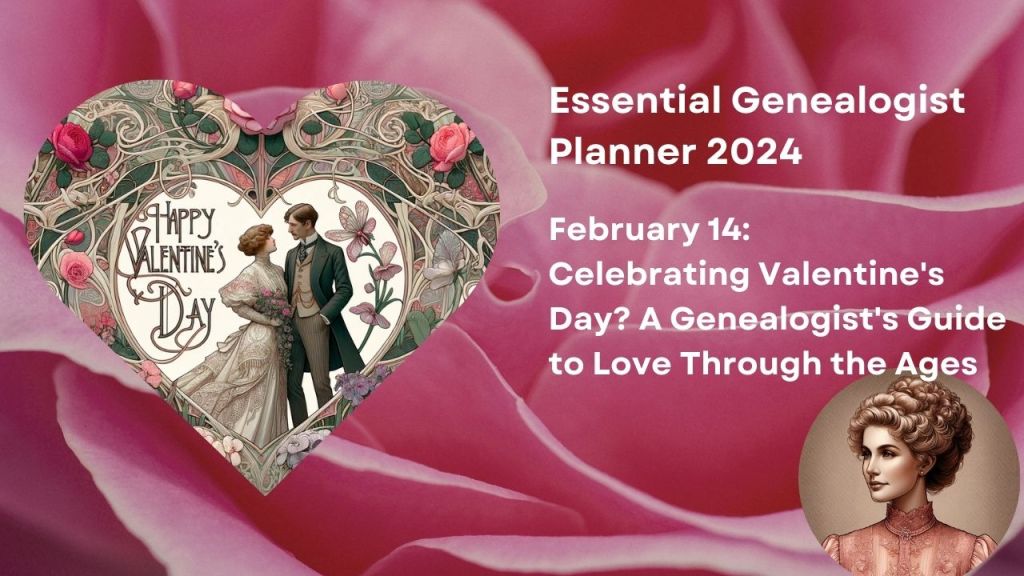
Genealogy Twist
For genealogists and family historians, Valentine’s Day presents a unique opportunity to incorporate the threads of their family history into the celebration of love. Whether you’re a seasoned genealogist or just beginning your journey into the past, this Valentine’s Day can become more meaningful with a touch of historical sentimentality. Here’s how to celebrate Valentine’s Day with a genealogy twist, drawing on both traditional customs and original ideas designed for genealogy enthusiasts.
Incorporating Family History into Valentine’s Day Celebrations
Genealogists can use Valentine’s Day as an occasion to delve into the love stories that have shaped their family’s past. From treasured wedding photos that capture the essence of bygone eras to love letters exchanged between ancestors, these artefacts offer a glimpse into the romantic lives of those who came before us. Creating a mosaic of ancestral love stories, perhaps through a collection of photos, letters, and biographical sketches, can be a touching tribute to your family’s legacy of love.
Crafting personalised Valentine’s Gifts with Genealogy Research
For a truly unique gift, consider using genealogy research to craft personalised presents. Imagine presenting a family member with a detailed family tree that highlights the romantic connections that helped weave the tapestry of your family’s history. Or, compile a booklet of love letters found in your ancestry, alongside stories of how these couples met and lived. These gifts not only celebrate Valentine’s Day but also enrich your family’s understanding of their heritage.
Exploring Love Stories from Your Family’s Past
This Valentine’s Day, take a moment to explore the love stories hidden within your family tree. Do you have a treasured wedding photo or love letters exchanged between your ancestors? Sharing these stories, whether through a family blog, a digital slideshow, or a cozy storytelling evening, can bring generations together and breathe life into your family’s history. Moreover, discovering the traditions and celebrations of love from your ancestors’ cultures can add a layer of depth to your own celebrations.
Unearthing Valentine’s Day Traditions from Ancestors’ Cultures
Valentine’s Day traditions have evolved over centuries, and exploring how your ancestors celebrated love can be fascinating. Historical research might reveal unique customs from your family’s country of origin, offering new traditions you can incorporate into your celebration. For example, Victorian England celebrated with elaborate paper Valentines, while in Scotland, Valentine’s Day involved festivals where young singles could find a match.
Reflecting on Your Romantic Tale
As genealogists, we’re deeply connected to our past, but it’s also important to remember our place in the continuum of our family’s history. Reflect on your romantic tale and how it connects with your family’s past. Are there parallels, contrasts, or direct influences from the love stories you’ve uncovered in your research? Sharing these reflections can be a profound way to celebrate Valentine’s Day, linking the past, present, and future in a celebration of love.
Celebrating the Most Romantic Ancestors
Finally, take a moment to consider which of your ancestors were the most romantic, and why. Was it the couple who overcame great obstacles to be together, or perhaps an ancestor who penned heartfelt love letters? Celebrating these individuals and their stories of love can serve as a reminder of the enduring power of affection across generations.
Valentine’s Day is more than just a day for current loves; it’s an opportunity to honour the love stories that exist throughout our family’s history. By incorporating genealogy into your Valentine’s Day celebrations, you create a deeply personal and meaningful experience that honours the past while celebrating the present. This February 14th, let’s remember that every love story, past and present, contributes to the rich tapestry of our family’s history.
—
I hope this blog post inspires you to celebrate Valentine’s Day with a nod to your ancestors and their stories of love. If you’re looking for more genealogy tips or creative ways to explore your family’s past, be sure to visit Essential Genealogy Journey 2024 for guidance on your essential genealogist journey.

History of Valentine’s Day
The history of Valentine’s Day and its patron saint is shrouded in mystery. However, what is known combines both Christian and ancient Roman traditions. Here’s a comprehensive overview written by my favourite GPT – Ancestral Artist:
Ancient Origins
Lupercalia: Some believe that Valentine’s Day is celebrated in the middle of February to commemorate the anniversary of Valentine’s death or burial—circa A.D. 270. Others claim that the Christian church may have decided to place St. Valentine’s feast day in the middle of February to “Christianize” the pagan celebration of Lupercalia. Lupercalia was a fertility festival dedicated to Faunus, the Roman god of agriculture, as well as to the Roman founders Romulus and Remus, celebrated on February 15.
St. Valentine
Multiple Valentines: There are at least three different saints named Valentine or Valentinus, all of whom were martyred. One legend contends that Valentine was a priest who served during the third century in Rome. When Emperor Claudius II decided that single men made better soldiers than those with wives and families, he outlawed marriage for young men. Valentine, realizing the injustice of the decree, defied Claudius and continued to perform marriages for young lovers in secret. When Valentine’s actions were discovered, Claudius ordered that he be put to death.
Other stories suggest Valentine may have been killed for attempting to help Christians escape harsh Roman prisons, where they were often beaten and tortured. According to one legend, an imprisoned Valentine sent the first “valentine” greeting himself after he fell in love with a young girl—possibly his jailor’s daughter—who visited him during his confinement. Before his death, it is alleged that he wrote her a letter signed “From your Valentine,” an expression that is still in use today.
Spread of Valentine’s Day
Middle Ages: By the Middle Ages, Valentine would become one of the most popular saints in England and France. The tradition of Valentine’s greetings had already begun by the 15th century, albeit in the form of spoken words or written letters.
Commercial Cards
The oldest known Valentine still in existence today was a poem written in 1415 by Charles, Duke of Orleans, to his wife while he was imprisoned in the Tower of London. The commercial revolution of Valentine’s Day cards did not occur until much later, in the 18th century, beginning with handwritten notes and leading to the mass-produced greeting cards of the 19th century, a tradition that has continued to grow.
Valentine’s Day Today
Valentine’s Day is now celebrated in many countries around the world, mainly as a day to express love and affection towards romantic partners, friends, and family. It has become heavily commercialized, marked by the exchange of gifts, chocolates, flowers, and greeting cards. Despite its historical and religious roots, Valentine’s Day has evolved into a global celebration of love and affection, transcending its origins to become a key date in the social calendar.
The history of Valentine’s Day is a testament to the enduring power of love and the human desire to celebrate connections, regardless of the origins or the exact identity of its namesake saint.

