Genealogy Planning
- Are you planning to embark on an adventure into your family’s past?
- Are you already deep into the annals of your ancestral heritage?
- Do you want to preserve your family history for future generations?
I have spent many years in my genealogy pursuit, developing my skills as a confident researcher, analyst, explorer, storyteller, family historian, and author.
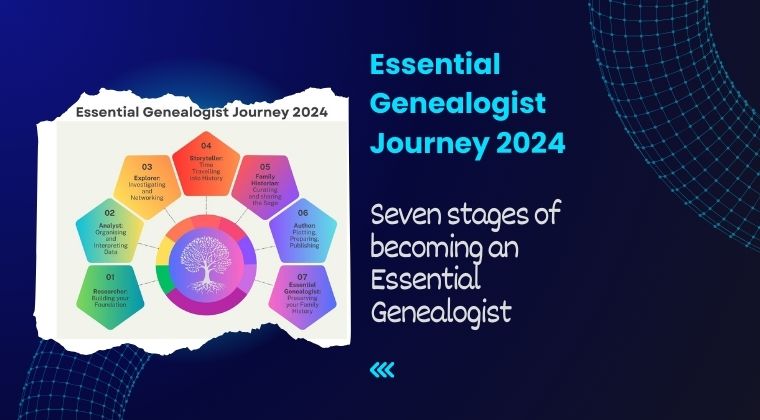
I have developed a seven-step process for conducting genealogical research and preserving family history.
The steps are visually represented as interconnected hexagons surrounding a central image of a tree, which symbolises the family tree. The tree sits within concentric circles that represent the growing and expanding nature of genealogical research as one moves through the steps. The use of vibrant colours and interlocking shapes indicates that each step is an integral part of a continuous process.
Essential Genealogist Journey
Here’s a summary of each stage:
Researcher: Building your Foundation This step is about establishing the basic groundwork for genealogical research, by gathering initial information and resources.
This initial stage is fundamental, where one begins by collecting all known family information, documenting sources, and setting the groundwork for a structured genealogical search. It involves identifying what you know, what you want to find out, and planning how to gather that information, such as reaching out to family members, and organizing initial findings.
Analyst: Organising and Interpreting Data In this phase, the gathered information is sorted, organised, and analysed to make sense of the data collected.
At this stage, the genealogist must sift through the collected data, discern patterns, and interpret findings. It’s about making connections between different pieces of information, understanding the reliability of sources, and forming hypotheses about family history that need further investigation. This often involves creating charts, timelines, and possibly using software to keep the growing amount of information well-organized and accessible.
Explorer: Investigating and Networking This suggests a more in-depth phase of research involving active exploration and reaching out to others, to find connections and additional information.
The explorer phase is characterized by active research and outreach. Genealogists delve into archives, libraries, and online databases for public records like censuses, birth and death certificates, and immigration documents. Networking with other genealogists, joining societies, and participating in forums can also be crucial in uncovering hard-to-find information and learning from the experiences of others.
Storyteller: Time Travelling into History At this stage, the researcher begins to construct narratives from the information, effectively “travelling” back in time to understand the context of their ancestors’ lives.
This creative stage involves piecing together the lives of ancestors, giving context to the bare facts. Genealogists here may study historical events, cultural practices, and social conditions of the times and places their ancestors lived in. The goal is to create a vivid narrative that goes beyond dates and places to include stories, personal challenges, and triumphs, effectively bringing ancestors to life for modern-day relatives.
Family Historian: Curating and Sharing the Saga This refers to the process of compiling the family history into a coherent story and sharing it with others, within the family, or with a wider audience.
Now the genealogist takes on the role of curator, deciding how to best compile and present the family’s story. This might involve creating detailed family trees, writing biographical sketches, or even producing documentaries. Sharing these stories can be done through family reunions, websites, or social media, allowing family members to engage with their shared heritage and ensuring the stories are passed down.
Author: Plotting, Preparing, and Publishing Here, the focus shifts to presenting the family history in a formalised way, through writing and publishing a book or a digital history.
For those wishing to formalize their family history, this stage involves the actual writing, designing, and publishing of a family history book or website. It requires careful planning of the content, layout, and how to incorporate images and documents. This stage may also involve learning new skills or collaborating with professionals to produce a polished, engaging, and well-documented account.
Essential Genealogist: Preserving your Family History The final step involves taking actions to ensure that the family history is preserved for future generations, which may include archiving documents or creating digital records.
The culminating phase of the genealogist’s journey is focused on preservation. The objective is to ensure that the wealth of information and stories collected will endure for future generations. This could involve digitizing documents, uploading data to online genealogy services, or creating physical archives. It’s also about teaching the next generation the importance of this information, so they can continue to add to it and keep the family legacy alive.
Each stage builds upon the last, creating a comprehensive approach to genealogical research that not only uncovers the past but also preserves it for the future.

