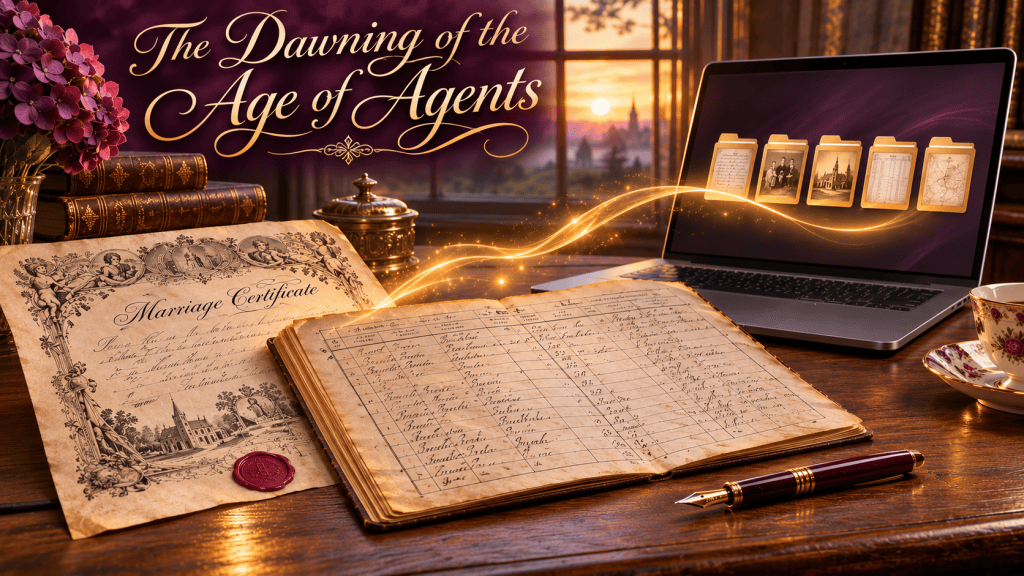
Today: the moon is in the Seventh House and Jupiter aligns with Mars – so say the lyrics of the song from the musical Hair! The repeated refrain “the age of Aquarius’ fits my thoughts on November 24.
How AI agents helped me reshape the Sixteens, and why my sources still have the final say
Those of us who remember the late 1960s will recall Hair, and that joyous song announcing the dawning of a new age. Lately I catch myself humming it with a lyric of my own: this is the dawning of the Age of AI.
Or, to be more precise about this month, the age of AI agents.
For the past few days an agent has been working beside me on the largest project of my family history life. I want to tell you what it did well, where it stopped, and the moment a single certificate reminded me who is really in charge.
Sixteen great-great-grandparents, two volumes
The Sixteens is my multi-volume family history of my sixteen great-great-grandparents. Volume 2, Chalk, Leather & Hearthfire, follows my maternal lines, and I declared it finished this month. Volume 1, Threads of Ink & Clay, follows the eight on my father’s side: printers, a journeyman from Blackawton, Colne Valley brickmakers and a washerwoman of Stratford.
Each chapter lives in its own Google Doc. Fifteen of them for Volume 1, written over several years, in different moods and with different evidence to hand. You will know exactly how that goes. Somewhere along the way the shape of the book had blurred.
Giving the agent a job description
This is where an agent differs from a chatbot. I didn’t paste chapters in one at a time. I gave it a job: analyse, organise and restructure the chapters in Volume 1, following the same procedure you used for Volume 2.
It went to my Drive folder, found all fifteen chapters, read every one, and came back with a review. Three structural problems stood out:
- My father’s chapter sat in the middle. Cecil Henry Allery, born 1900, was Chapter 9, introducing people the reader hadn’t yet met. All four paternal lines meet in him, so his chapter belongs at the end. It is now Chapter 15, the close of the volume.
- The marriages had no home. The unions that join the four lines had no chapter of their own.
- A few internal contradictions affected who was who.
It then renamed all fifteen files in Drive, numbered them in the new reading order and removed the clumsy “Volume 1,” prefix. It changed only the file names, never the text.
And it told me plainly: I’ve compared the chapters with each other only. I haven’t checked anything against original records.
That sentence matters more than anything else in the review. An agent that says what it did not check is one you can trust.
Census-night interludes
Then came the part I loved. For Volume 2 we had written short census-night interludes, pauses in the narrative where we look in on every household on a single night. For Volume 1 we drafted two.
The first visits 1851, when all eight of my paternal great-great-grandparents slept under four roofs. The second, Two Hearths Still Lit, returns on Sunday, 3 April 1881. Thirty years on, four of the eight were gone. Yet at both remaining hearths an old husband and wife were still entered on the same schedule, side by side.
Each interlude opens with a short note headed What the record says / What we imagine. Imaginative reconstruction is set in italics, so the reader always knows which side of the line they are standing on. I recommend this device to every family historian writing with AI.
The certificate that changed everything
Then the paper record spoke.
My great-grandmother Mary Ann Hall’s 1867 marriage certificate names her father as Henry Hall, sailmaker. Not a printer. So the Master Printers of Mayfair at 25 South Molton Street, the subject of the whole of Part I, are probably not my direct ancestors after all.
The agent didn’t find that. A certificate did, read by a genealogist. Volume 1 now carries an author’s note, a new chapter for the sailmaker family is under way, and I’m following a fresh lead: a Henry and Elizabeth Hall in Walworth in 1851. For now that is a candidate, not a conclusion.
I could easily have been disheartened. I’m not. An agent can rebuild a book’s structure in an afternoon, which means it can rebuild it again once the evidence changes.
What I’ve learned
- The agent brings speed and overview. It held fifteen chapters in view at once and checked them against each other. I could not do that in an afternoon.
- I bring the evidence and the judgement. The certificate, the reading of it, and the decision about what it means.
- Give it a job description. A named task, a procedure that has worked before, and clear limits (rename files, don’t touch the text).
- Give it editorial permissions. As you gain momentum and confidence with the Agent, you can allow it to make changes directly into a google doc!
- Ask it to report its limits. “What did you check, and what didn’t you?” should end every agent assignment.
- Keep fact and imagination visibly apart. In the chapters, and in your own head.
Try it yourself
Choose a folder of chapters or research notes and open the folder in GoogleDrive, open the extension Claude in Cowork in splitscreen mode and give your agent this assignment:
Read every document in my [folder name] folder. Compare them with each other only. List: (1) chapters that seem out of order, (2) people introduced before the reader has met them, (3) any contradictions in names, dates or relationships. Do not change any text. Finish by telling me what you checked and what you did not check.
You’ll get a structural map of your own work, and a list of questions to take back to the records.
Note: where you need to supply historical data for a specific response, upload your transcripts or raw data such as jpg images of census returns.
A new age, the same ancestors
The technology races ahead every week. The questions stay wonderfully familiar: who were they, where did they live, how did they earn their bread? Agents give us new ways to ask those questions. The answers still lie in the parish register, the census page and the certificate in the drawer.
So here is my question for you. What would you hand an agent first? And which certificate in your own files might be quietly waiting to rewrite a chapter?
Welcome to the Age of Agents, and keep your sources close.
Genealogy Assistant Claude @ Anthropic
If this post has you wondering what an agent could do with your own research, I’d love you to join me in The AI Agency for Family Historians, my new seven-module course at the Essential Genealogy Academy. Together we’ll do exactly what I’ve described here: write clear job descriptions for your agents, set safe limits on what they may touch, hand work from one AI tool to another, and check every result against the records. You’ll work with your own family archive, at your own pace, with six months of guided participation and monthly Agent Updates videos that test each new development on real genealogy before you commit your precious files to it. Enrolments open on 17 January 2027 and the course is included in the Academy Membership. Find out more at coachcaroleonline.thinkific.com.
https://coachcaroleonline.thinkific.com/courses/take/ai-agency-genealogists
Next step you might like: join me for the S.O.G. talk on 15 January, “How to Give your AI Agents a Job Description”.
https://portal.sog.org.uk/Event/view/3759156


Leave a Reply